
The CQWW/96 Story
A RECORD LOST DUE TO 45 MINUTES OF POWER FAILURE
Just 45 fateful minutes without electrical power on Sunday evening, 27/10/96, spoiled our chances to win the CQWW Multi single/96 world record that was just within our reach.
The atmosphere was charged with tension and our nerves were high-strung, as we could never imagine that with the present propagation conditions, in the worst phase of the sunspot cycle, we might exceed 75% of the Master Score - however, the return we obtained was totally unexpected.
Propagation was non-existent, however this also applied to the noise, allowing us to hear "below S-Meter"signals on our equipments. After the first Contest Day, we began to believe in the possibility of at least approaching the Record. Early Sunday morning we started to make innumerable calculations, and each operation of the calculator motivated us more and more. Tension mounted in proportion with our adrenalin levels. Our best moment came on Sunday morning when the 10 meter band opened. The increasing multipliers kept increasing our hopes for our final Score. The conviction that the Record was our grew in our minds.
Our story ("ZX0F")began with Peter (PY5CC) and Zeca (Tower man) landing on the island of Fernando de Noronha on 17/10/96, to assemble antennas and towers as well as check out Andres station (PY0FF) including cable connectors, electrical cables and mounting the configuration of the station assembly we would be working with - Multi Single with a Running Station and another Multiplier Station.
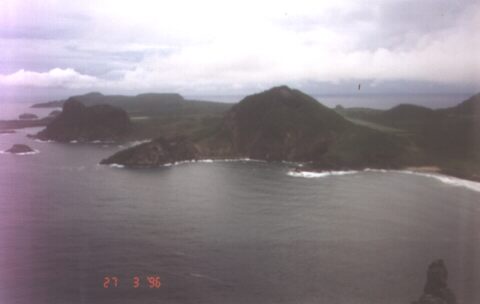 Photo Caption - Partial view of Fernando de Noronha Island |
Everything went marvelously well except for the FORCE12 80-meter 3-element Yagi which was delivered at the island on Wednesday, Oct. 23. But this delay was not going to be the only problem, - three days would be needed to assemble the antenna, not any antenna but one with a 30 meter long Boom plus more than 35 meters of elements, weighing approximately 200 Kg - this meant a difficult task to be carried out by Peter, Zeca and Andre. |
Anyway what they accomplished went well beyond normal possibilities. They readied the station for the for the M.S. modality. Their only foe was the heat that at this time of the year exceeds 351C - you may get sunburned as early as 08:00 a.m. in a location where theres full sunlight at 5:00 a.m.
On Thursday, Oct. 24 we arrived on the island - Augusto ("PY5GU") myself and Jim ("N5FA") early in the morning. Without time to rest, we changed clothes hurriedly, put on sun blocking cream and started to work, or better, to accelerate the work that was behind schedule. We unpacked the 80 meter Yagi and started to assemble the "BIG GUN". We spent the whole day mounting the Boom and two of the three elements. Many doubts pestered us during assembly because the "FORCE 12" antenna manual was not very helpful and Jim had to make no less than 5 telephone calls to their plant in the States.
On Friday, Oct. 25, our big Boss ( "PY5EG") Oms arrived, with a very bad cold - he could hardly speak. By the way, when I ("PY5GU") landed on the island, I was almost unable to stand due to a bad cold and I was not alone as Oms also caught cold in the perennialy freezing Curitiba, in S.Brazil. Our luggage included hundreds of pills and vitamins. We took a lot of care to avoid contaminating Jim and Peter - if Oms and I could not operate, at least the other two would proceed, so we could not afford to "undermine" them. Anyway we did not have time to think about our discomfort, we had to finish our job. When PY5EG arrived we were still running against time to conclude the assembly of the 80 meter antenna - it was Friday already, the day when the contest would begin; in the meantime Peter, Oms and Andre were hurrying to install an inverted "V" for 160 meters, while Jim and I entered the woods to run out a Beverage for this band.
The day was ending and the decision made following the assembly of each element and tuning thereof was that we needed to rest before the contest started. So we hoisted the driven element and fixed it to the tower using it as a "Diapolão" (big dipole) as the group called it. When it was up in the air some 20 meters high, a piece of element became loose and fell... So, down came the "Diapolão", to fix the element, tune it and hoist it up again... Poor Zeca...!
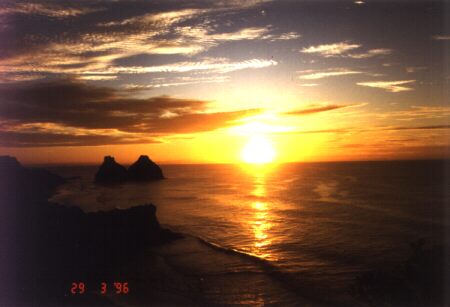 Photo caption - Sunset at one of the Island beaches, good for diving and surfing. At the background the "Two Brothers Island". |
Night fell and we had indoor jobs to do in the Shack - adjust the coaxial switches, rotors, parallel wiring for the battery in case of an ceventual power failure, and prepare the computers for on-line operation, and test everything. We had dinner and got back to the Shack. Suddenly we realized what was happening, Jim had already started the contest as it was 10:00 p.m. (Local time). Oms took over the multiplier station while Peter and I managed the station and monitored the rotors, linear, antennas, output power, antenna SWR=s, etc. We started with the 40 meter band, the best option for the QTR. |
When the Contest started we were a bit tired, as we still had to finish the 80-meter Yagi. During the next few hours our frustration disappeared due to the results we obtained from the "Diapolão" it made us very happy due to its excellent reception and to the large signal it offered to the multipliers. We started to chart zones, countries, etc. Closing the first 24 hours with approximately 4,800 contacts. While Jim and Oms operated, Oms now at the 40 - meter Running station and Jim at the multipliers, Peter and I went to bed, it was 3:00 a.m. A few hour later we replaced them to let them also obtain some rest.
The main worry of the group was the possibility of a power failure - during the last WPX in March, on the same island, the lights went off for 1 hour right at the start of the contest when we had an average of 300 contacts/hour.
Almost every weekend the State Power Station - CELP - Centrais Eletricas de Pernambuco - changes over with shutdown of the Island generators for maintenance. So we asked Andre to call the Power Station and ask them about any planned power failure that weekend, to prevent any frustration. They answered that no power failure was expected so we calmed down.
During the first hour of Saturday, without any logical explanation, one of our computers went dead. Following a lot of confusion and 5 minutes of elapsed time, the computer returned to normal. We continued to man the stations, guided by propagation but without much logic, considering that in the week prior to the Contest the 10 - meter band had been open almost the whole day with very strong signals. On Saturday, however, we weren=t able to reach more than 100 stations on the Band. On the other hand, the 15 - meter was in a crazy state. Pileups were constant for many hours. The 40, 80 and 160-meter bands did not exceed the rule, that is, only during the night and early mornings. The 20-meter band was open the whole day but with much less activity than the 15 meter one. We started to compare and plot our estimated result for the end of the Contest. Our calculations were encouraging as they showed that, if we could maintain the average of the first half period we would break the 1993 "PJ1B" world record of 22,596.570 points and 9,386 contacts. However, on Saturday night the propagation conditions were unfavorable and the score rate declined a little.
On Sunday the 10-meter band opened in the morning and we felt encouraged once again. We started to add points through new Multipliers and new Zones. It went on during the whole day, meaning that we never stopped operating the stations, not even for one second. Our score was growing, as we were working two stations simultaneously. "Running" was working at full sail while the "Multiplier" searched for new Multipliers.
Sunday night our calculations showed that we might break the record by a slim difference but we would do it. Our of the possible Zones within the 15-meter band we had left only two out and within the 20-meter band only 6 Zones were left out. The 40-meter band was not different. Our biggest deficiency was working more Multipliers in the 160-meter band because we did not have a larger higher gain antenna.
We were that hopeful, the improbable was about to happen during the low propagation status. Our main competitor, the "N6KT" team that operates from Galapagos ("HC8N") that was being monitored by us and was not doing as well as ARAUCARIA team ("ZX0F"). Lots of adrenalin added to our anxiety and high strung nerves - we had to take advantage of the opportunity - who knows when similar conditions would occur again?
But at 8:00 p.m. (Local time), just two hours before the end of the Contest.... the lights went out. The Island suffered a power failure right in the middle of a pile up. Jim operated and maintained an average of 320 contacts/hour for one additional hour and a half. We froze for at least 2 minutes. Then we started to run; while one tried to switch the radio to batteries another tried to phone CELP to find out what was going on. After 20 minutes in the dark, feeling extremely nervous, we switched the Radio to Running with 100 watts only, however with loss of the "pile up" frequency and the "pileup" we lost also electrical control of the coaxial relay switches and rotors. We ran to make direct connections to the antenna. The Power Station made excuses, we tried to continue the operation, but our dream of breaking the record, that had been born on the second contest day, had died.
The only thing in our minds was "WE DID NOT BREAK THE WORLD RECORD DUE TO 45 MINUTES OF POWER FAILURE", something that did not depend on our will, competence, working capacity or dedication.
Our final CQWW/96 score at Fernando de Noronha Island was 21,762,636 points, 8,600 contacts, 690 countries, 171 zones.
| Qso’s | Zones | Countries | |
| 10 meters | 1078 | 30 | 135 |
| 15 meters | 3794 | 36 | 160 |
| 20 meters | 1645 | 38 | 160 |
| 40 meters | 1856 | 32 | 121 |
| 80 meters | 259 | 26 | 86 |
| 160 meters | 28 | 9 | 28 |
Total Score: 21,762,636
Till the WPX/97 - certainly with a better 160-meter system and OUR OWN GENERATOR!